Printing, natural philosophy, and diplomacy
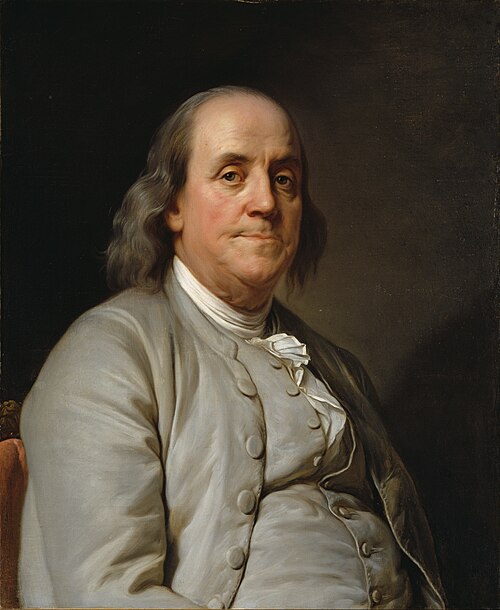
Benjamin Franklin
1706–1790 · United States
Franklin was born in Boston in 1706, the fifteenth child of a soap-and-candle maker, and was apprenticed to his brother's printing shop as a boy. He ran away to Philadelphia, built a printing business, and made his fortune publishing the Pennsylvania Gazette and Poor Richard's Almanack, whose proverbs about thrift and industry became the common currency of American self-improvement.
He retired early to study nature and public affairs. His experiments with electricity, above all the identification of lightning as an electrical discharge and the invention of the lightning rod, won him international fame and election to the Royal Society. He also founded a lending library, a fire company, and a philosophical society, and helped establish the University of Pennsylvania.
As a colonial agent in London and then as a diplomat in Paris, he argued the American cause before the courts of Europe, and in 1778 he secured the French alliance that made independence possible. He helped negotiate the peace of 1783 and then, at eighty-one, attended the Constitutional Convention, where his calls for compromise helped hold a divided gathering together. He died in Philadelphia in 1790.
Joseph-Siffred Duplessis · Public domain
Hosted
A dinner during the Convention · 1787 · Philadelphia, Pennsylvania
Attended
The evening before independence · 1776 · Philadelphia, Pennsylvania
The pamphleteer's table · 1776 · Philadelphia, Pennsylvania
The framer's working dinner · 1787 · Philadelphia, Pennsylvania