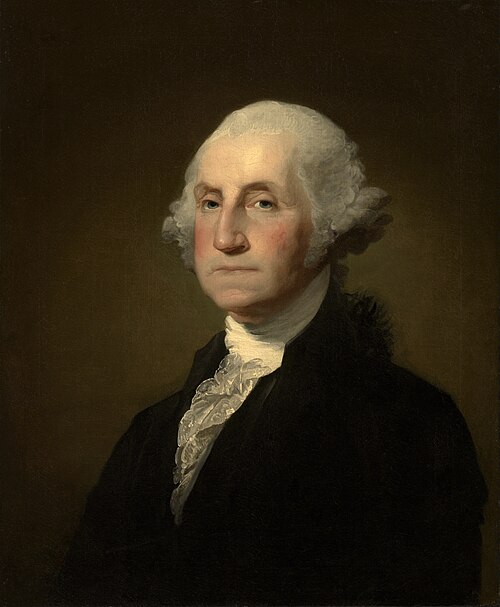
Soldiering, statesmanship, and the presidency
George Washington
1732–1799 · United States
Washington was born in 1732 into a Virginia planting family and trained as a surveyor before he inherited Mount Vernon and took up the life of a gentleman farmer and militia officer. His early service in the French and Indian War gave him a soldier's education and a reputation for steadiness under fire.
When the colonies took up arms in 1775, the Continental Congress chose him to command the army, less for battlefield brilliance than for his gravity and his willingness to serve without pay. He held a ragged force together through years of defeat, and his refusal to become a military dictator at the war's end made him the new republic's most trusted citizen.
He presided over the Constitutional Convention in 1787 and was elected president unanimously the following year. In two terms he established the cabinet, the precedent of a peaceful transfer of power, and the authority of the federal government, then retired voluntarily to Mount Vernon, where he died in 1799.
Gilbert Stuart · Public domain
Hosted
The general's table at Mount Vernon · 1790 · Mount Vernon, Virginia
The farewell dinner · 1796 · Philadelphia, Pennsylvania
Attended
The evening before independence · 1776 · Philadelphia, Pennsylvania
The young Frenchman's supper · 1781 · Philadelphia, Pennsylvania
A dinner during the Convention · 1787 · Philadelphia, Pennsylvania
The framer's working dinner · 1787 · Philadelphia, Pennsylvania
Publius at table · 1788 · New York, New York